Discover · Disentangle · Generate

SAGE: Salient Factor Discovery and Generation with Visual Foundation Representations

Preprint 2026

Shuang Liang1,2,†, Lejun Liao2,†, Shiyuan Zhang2,3,†, Max C. Zhang2, Xiaolong Luo4, Han Wang1, Stefano Anzellotti2, Yuan Yuan2,*
1The University of Hong Kong 2Boston College 3University of Virginia 4Harvard University

†Equal contribution. *Corresponding author.

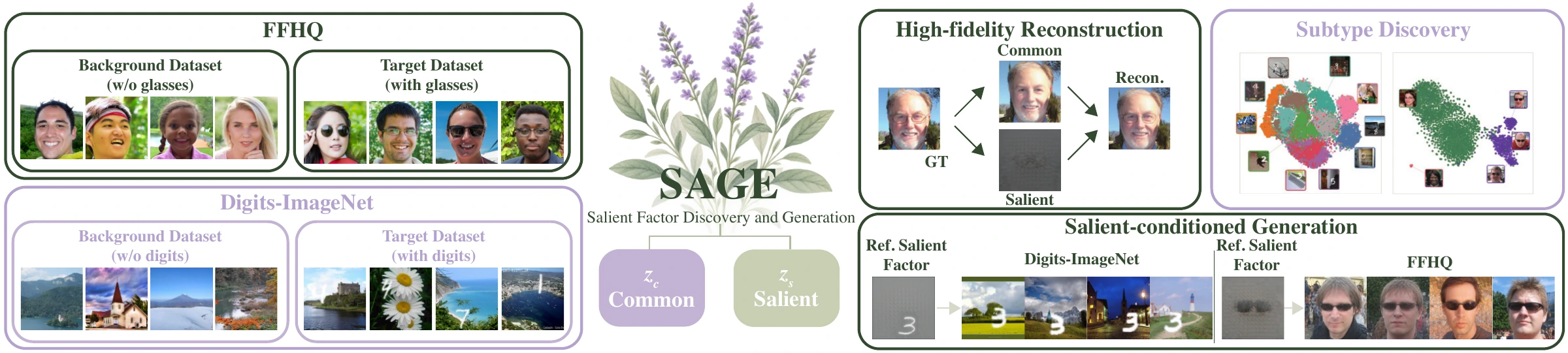
SAGE overview: separating common and salient factors enables high-fidelity reconstruction, subtype discovery, and reference-conditioned generation.
Discover what makes the target different. SAGE learns common content and target-specific salient factors from background and target datasets. The same representation supports reconstruction, subtype discovery, and generation guided by a reference image.

From a visual difference to a discoverable, generative factor.
No subtype labels. No text description required.

Abstract

Given a target dataset, such as faces with eyeglasses, and a background dataset, such as faces without, contrastive analysis separates salient factors specific to the target from common content shared by both. We aim for salient representations that capture target-specific detail in each image, such as the shape, color, and position of the glasses, so that they reveal subtypes without subtype labels and guide the generation of new examples of a discovered subtype, even one with no name or text description.

We introduce SAGE, which learns both factors directly in the high-dimensional spatial latent of a frozen representation autoencoder and conditions a diffusion transformer on the learned salient representation of a reference image. On Digits-ImageNet and FFHQ eyeglasses, SAGE combines high-fidelity reconstruction (rFID below 2) with unsupervised subtype discovery, recovering the digits better than baselines (probe accuracy 0.950 vs. at most 0.281) and revealing eyewear types, finer sunglasses styles, and mislabeled images; salient-conditioned generation raises Digits-ImageNet subtype accuracy over the unfactorized latent (90.5% vs. 27.7%) and diversity on both datasets. On retinal OCT, SAGE's salient space separates three diseases using only normal/disease labels.

The approach

One representation, two stages

Learn the difference between two datasets, then use that difference to generate new examples.

01Discover common and salient factors

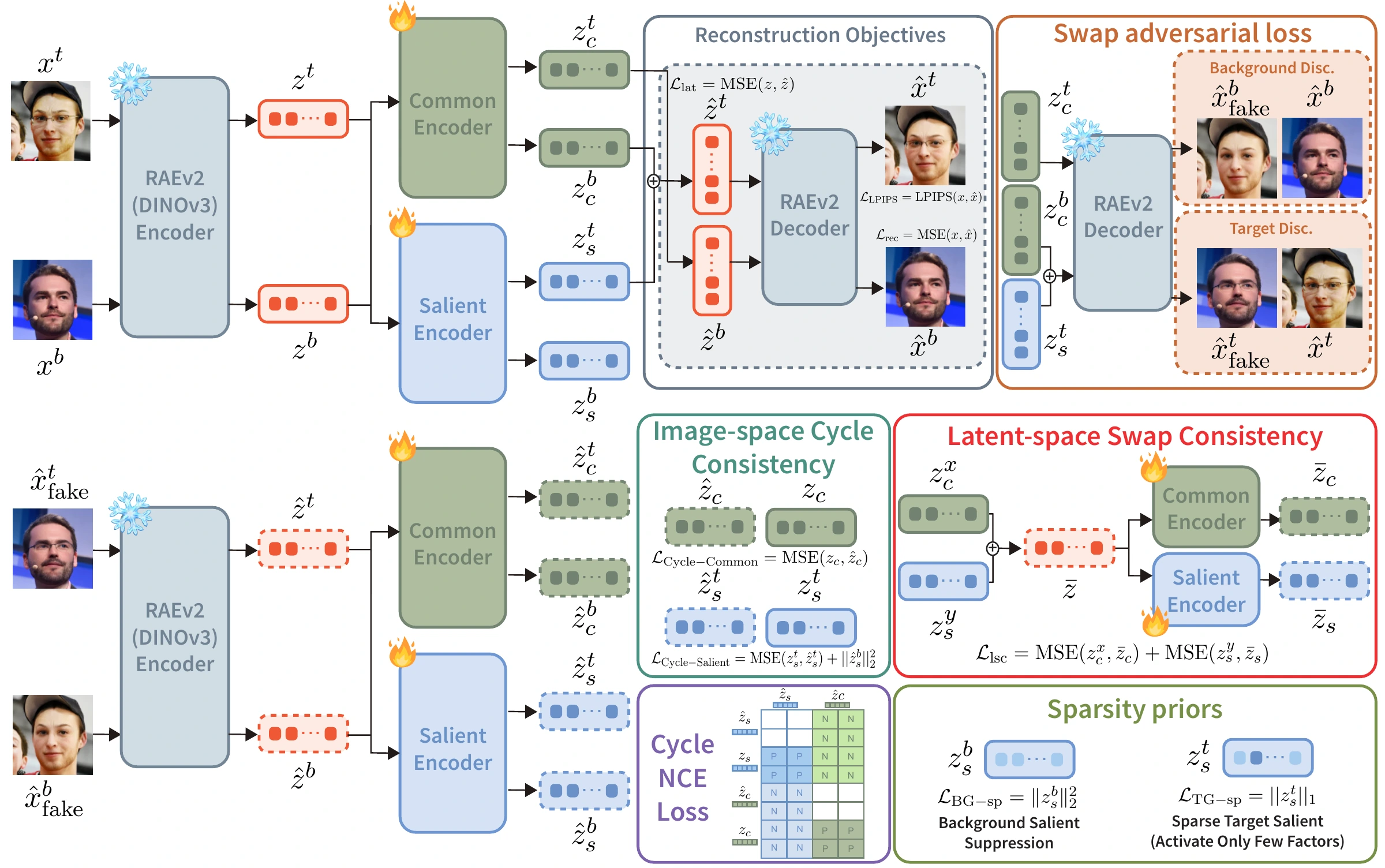
A frozen representation autoencoder provides a rich spatial latent. SAGE learns separate common and salient encoders in this space: common factors capture shared content, while salient factors capture what is specific to the target dataset. Reconstruction, adversarial swapping, sparsity, and cycle consistency encourage the two factors to stay informative and distinct.

Stage 1 architecture with frozen representation autoencoder, common and salient encoders, factor swapping, reconstruction, and training losses.
Stage 1: factor discovery. SAGE learns directly in the high-dimensional spatial representation, preserving the visual detail needed for both reconstruction and subtype discovery.

02Generate from a reference's salient factor

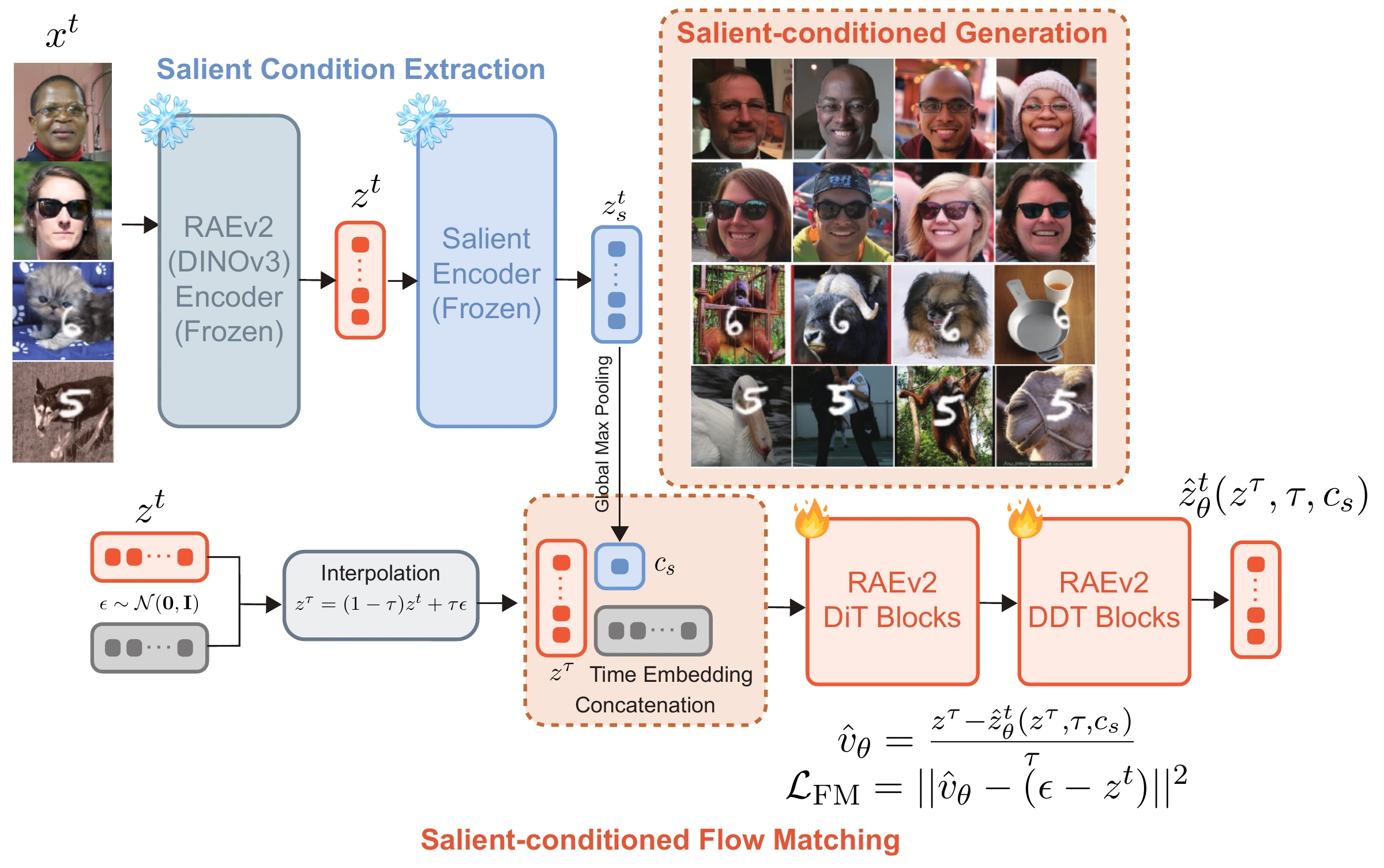
The learned salient representation of a reference image is globally max-pooled and used to condition a diffusion transformer. This guides generation toward the reference's digit or eyewear subtype while allowing the surrounding scene or face to vary.

Stage 2 uses the pooled salient representation from a reference image to condition a diffusion transformer and generate diverse images of the same subtype.
Stage 2: salient-conditioned generation. A visual reference provides the condition, including for subtypes that have no name or text description.

Experiments

Reconstruct faithfully. Discover fine-grained subtypes.

Evaluated on Digits-ImageNet, FFHQ eyeglasses, and retinal OCT.

High-fidelity reconstruction and factor separation

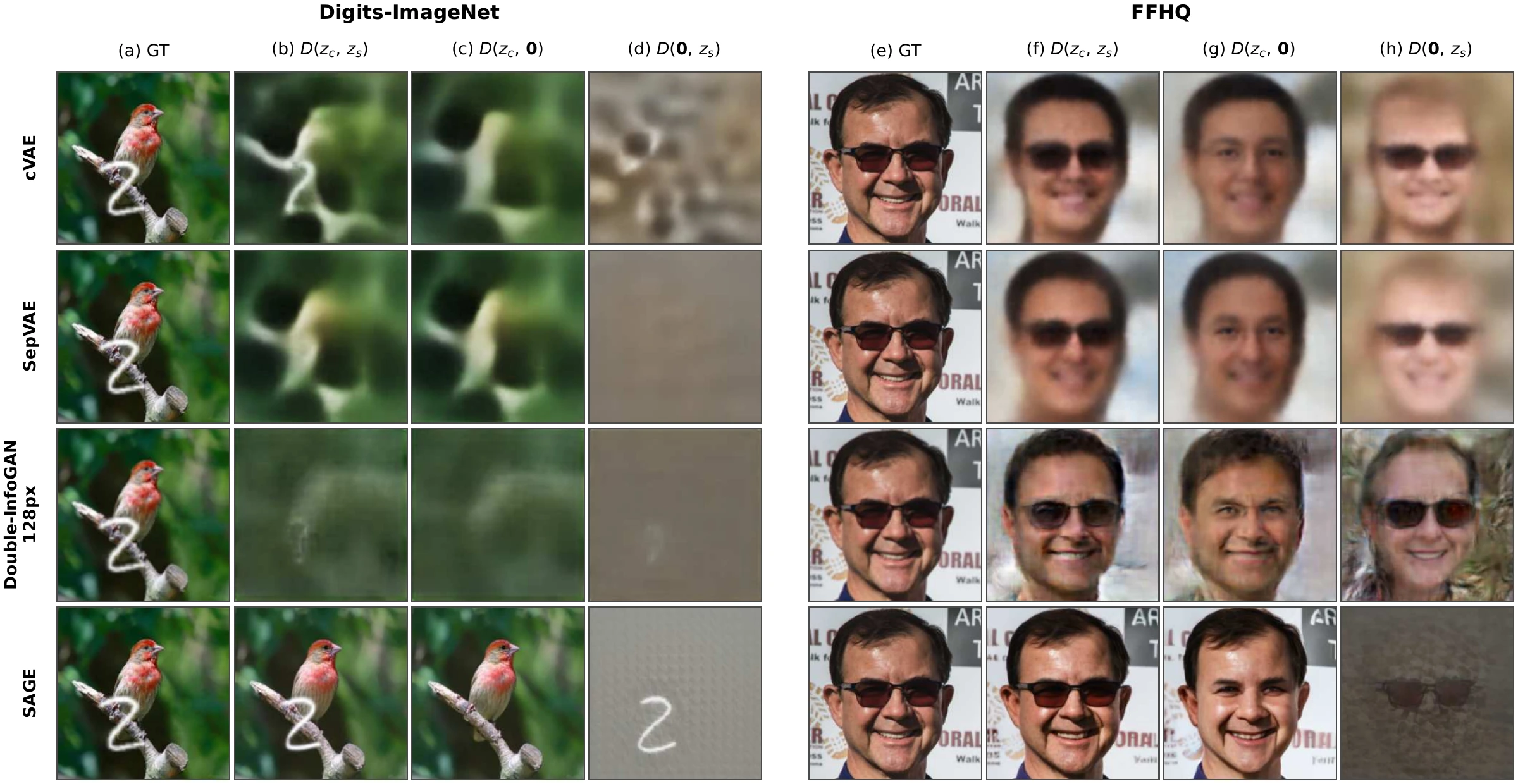
Reconstruction comparison of cVAE, SepVAE, Double-InfoGAN, and SAGE, showing full, common-only, and salient-only reconstructions for digits and eyeglasses.
Decoding the two factors. Full reconstructions preserve image detail; common-only and salient-only reconstructions reveal the separation between shared content and target-specific attributes.
Reconstruction and subtype discovery
MethodDigits-ImageNetFFHQ
rFID ↓Probe acc. ↑ARI / NMI ↑rFID ↓Probe acc. ↑ARI / NMI ↑
cVAE151.00.1350.001 / 0.003188.20.8980.001 / 0.001
SepVAE162.50.1450.009 / 0.019197.40.897−0.001 / 0.000
Double-InfoGAN171.40.2810.001 / 0.003122.50.9640.298 / 0.299
SepCLRN/A0.1800.000 / 0.001N/A0.9700.822 / 0.696
DINOv3 + SepCLRN/A0.1480.000 / 0.001N/A0.9760.915 / 0.825
SAGE (Ours)1.780.9500.337 / 0.4721.650.9830.939 / 0.865

Lower rFID indicates better reconstruction. Probe accuracy, ARI, and NMI evaluate subtype information in the salient representation. FFHQ labels are audit-corrected. Double-InfoGAN uses 128 × 128 images; other methods use 256 × 256. N/A indicates no decoder. See the paper for the complete evaluation protocol.

Subtype discovery without subtype supervision

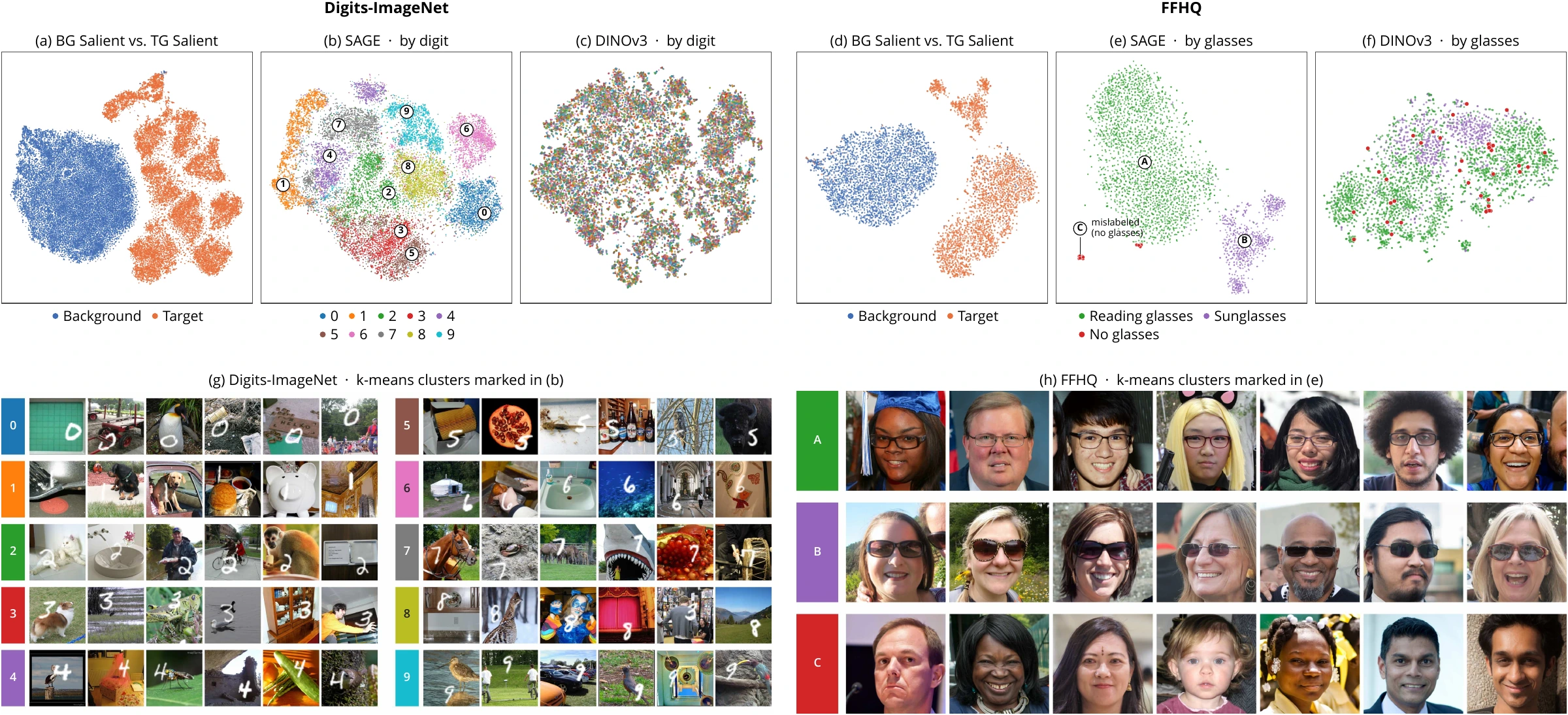
SAGE recovers digit identity and eyewear subtypes using only background/target dataset membership during training. The salient space also reveals finer sunglasses styles and a cluster of mislabeled FFHQ images.

t-SNE atlas of SAGE salient representations showing digit clusters, eyewear subtypes, finer sunglasses styles, and mislabeled images.
A closer look at the salient space. Visual subtypes emerge without subtype labels. The paper reports clustering metrics on the original representations, separately from these t-SNE visualizations.

Exploring the factors

Transfer, remove, and interpolate

Manipulate salient attributes while retaining the common content of an image.

Attribute transfer and removal

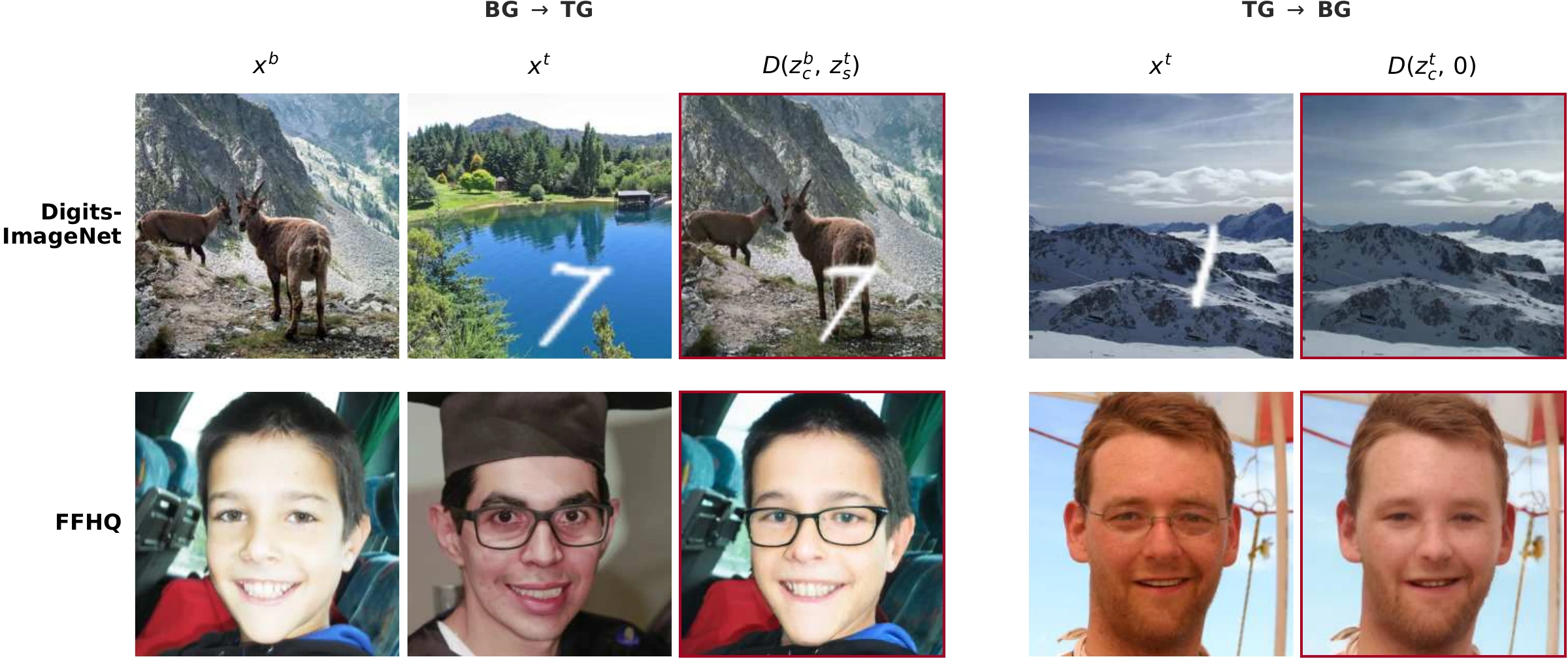
Transferring digits and eyeglasses between images by swapping salient factors, and removing them by setting the salient factor to zero.
Combine one image's common representation with another's salient representation to transfer an attribute. Setting the salient factor to zero removes the target-specific attribute.

Continuous interpolation

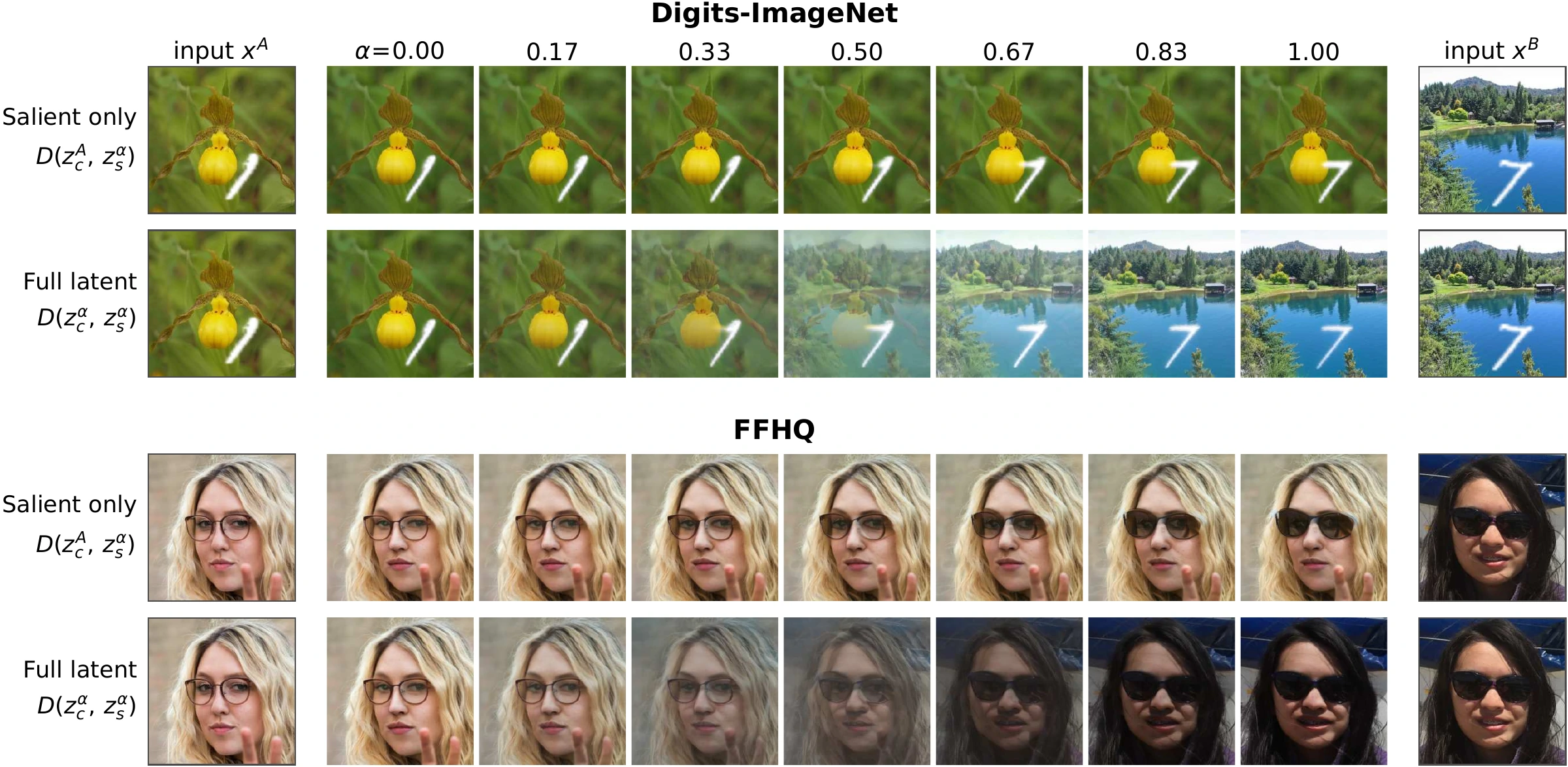
Salient interpolation changes a digit from 1 to 7 and regular eyeglasses into sunglasses while keeping the common representation fixed.
Fix the common representation and interpolate between two salient representations to move between digit identities or eyewear styles.

From discovery to generation

Same salient subtype. New visual content.

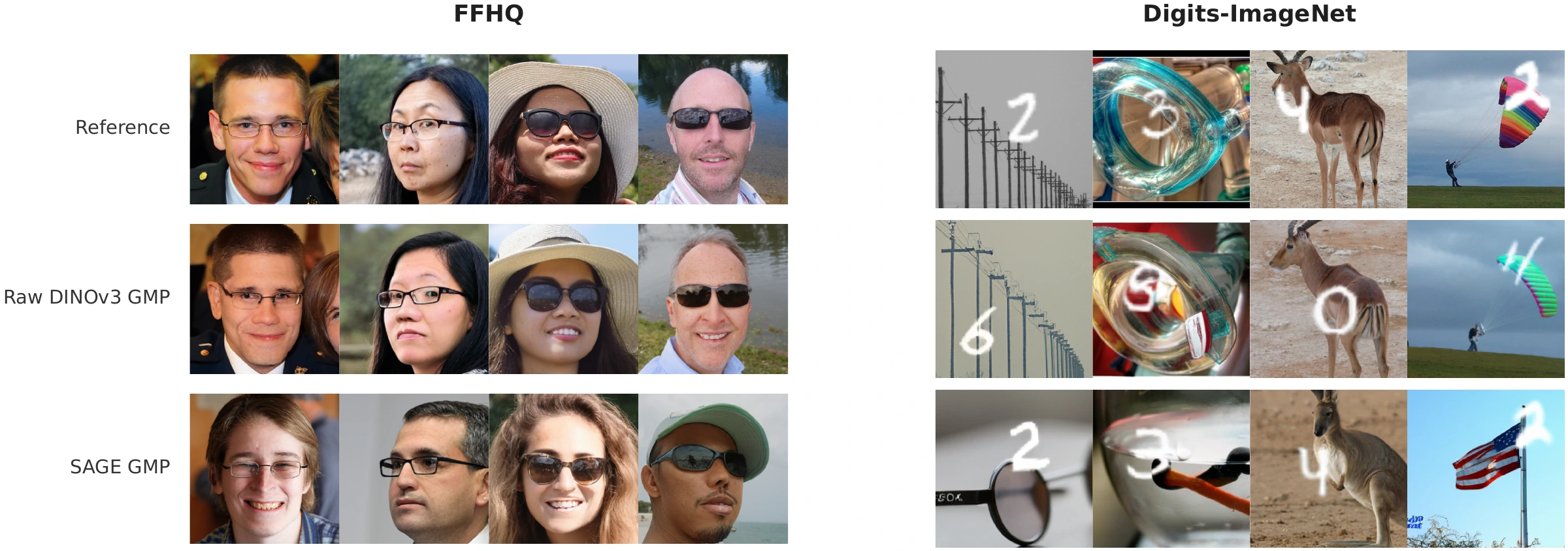
Conditioning on the separated salient factor encourages diverse samples that share the reference's target attribute.

Generated images conditioned on raw DINOv3 features versus SAGE salient factors, with diverse faces and scenes sharing the reference eyewear or digit subtype.
Salient-conditioned generation. Compared with conditioning on the unfactorized DINOv3 latent, SAGE increases diversity on both datasets and improves digit subtype accuracy.
Generation quality and diversity
DatasetConditioningSubtype acc. ↑Vendi ↑Cos-to-ref ↓
Digits-ImageNetRaw DINOv3 GMP27.70%2.650.794
Digits-ImageNetSAGE Salient GMP90.48%12.500.116
FFHQRaw DINOv3 GMP98.5%2.320.779
FFHQSAGE Salient GMP96.6%6.960.470

GMP: global max pooling. Vendi measures diversity across 16 samples per reference; cosine similarity to the reference uses DINOv2-L features. On FFHQ, SAGE increases diversity while subtype accuracy is slightly lower than raw DINOv3 conditioning. Full results, including generation FID, are in the paper.

Beyond natural images

Discovering retinal OCT disease subtypes

Using only normal/disease training labels, SAGE's salient space separates CNV, DME, and DRUSEN.

Retinal OCT examples with common and salient factor edits, alongside clusters for CNV, DME, and DRUSEN in the learned salient space.
Exploratory results on retinal OCT. The learned salient representation captures disease-related variation. The editing examples are qualitative research results.

BibTeX

@misc{liang2026sage,
  title={{SAGE}: Salient Factor Discovery and Generation with Visual Foundation Representations},
  author={Liang, Shuang and Liao, Lejun and Zhang, Shiyuan and Zhang, Max C. and Luo, Xiaolong and Wang, Han and Anzellotti, Stefano and Yuan, Yuan},
  year={2026},
  eprint={2609.39635},
  archivePrefix={arXiv},
  primaryClass={cs.CV},
  url={https://arxiv.org/abs/2609.39635}
}